
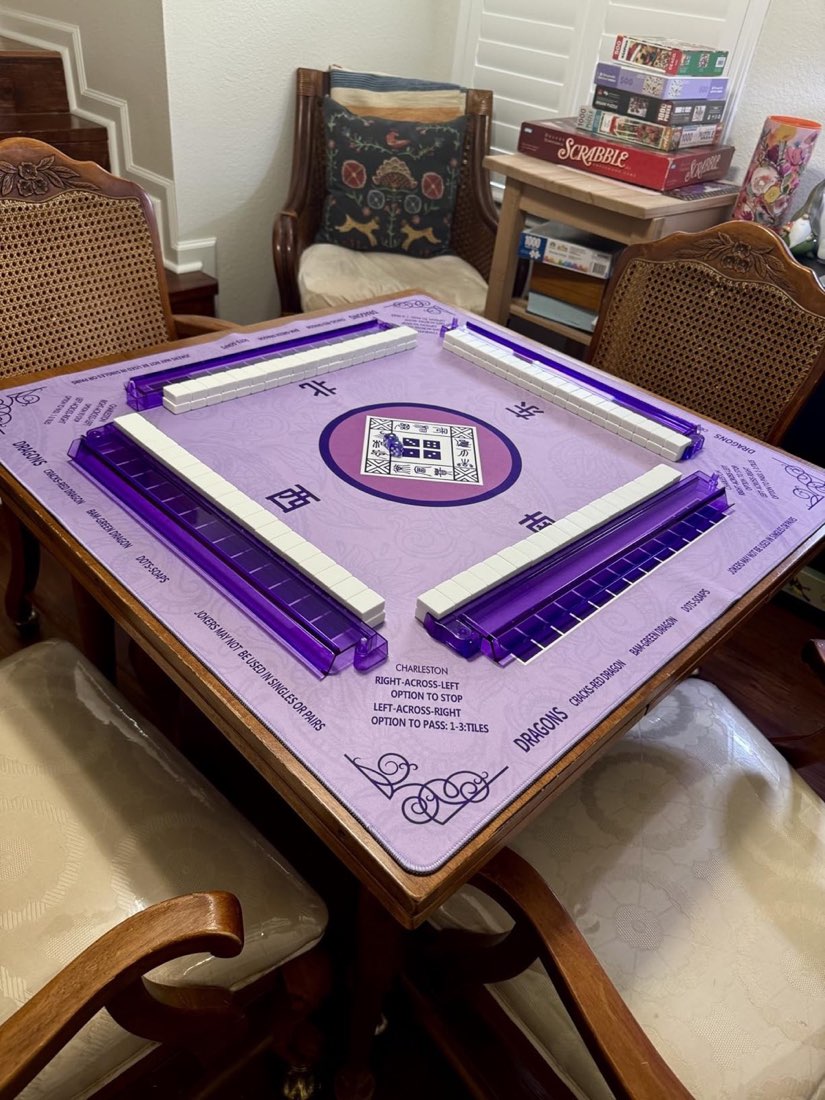
Lesson 01Getting started & accessories
American Mahjong is a tile game for four players. The goal is to complete a legal fourteen-tile hand on the current card and declare Mah Jongg.
This course teaches standard NMJL-style American Mahjong. Use the current NMJL card and rulebook for official hand requirements and rules, agree on any house-rule variations before play, and at tournaments follow the organizer’s published rules.
Tile rack and pusher
The rack holds your concealed tiles, while its top ledge displays exposed groups. Use the pusher to move your wall toward the center when it is needed, keeping the tiles face down and neatly aligned.
Dice
Dice may be used to select the first East player. Before each deal, East rolls two dice to determine where to break East’s wall.
East marker
The East marker identifies the dealer. Place it in front of East so everyone can see who will deal and begin the round.
Chips or a score sheet
Chips are optional tools for tracking points. Agree on the value of each chip color before play, keep chips beside the rack, and use only as many denominations as your group needs. Chips do not change the rules, hand structure, or calling priority.
Lesson 02Tiles, groups & reading the card
Standard American Mahjong play uses 152 tiles: 108 numbered suit tiles, 16 Winds, 12 Dragons, 8 Flowers, and 8 Jokers. A retail set may include additional tiles or blanks. Set these extras aside before shuffling; they are not used in standard NMJL play.
Numbered tiles
There are three suits: Craks, Dots, and Bams. Each suit has numbers 1 through 9, with four copies of every tile.
Craks

Dots

Bams

The one-Bam is usually represented by a bird.
Winds
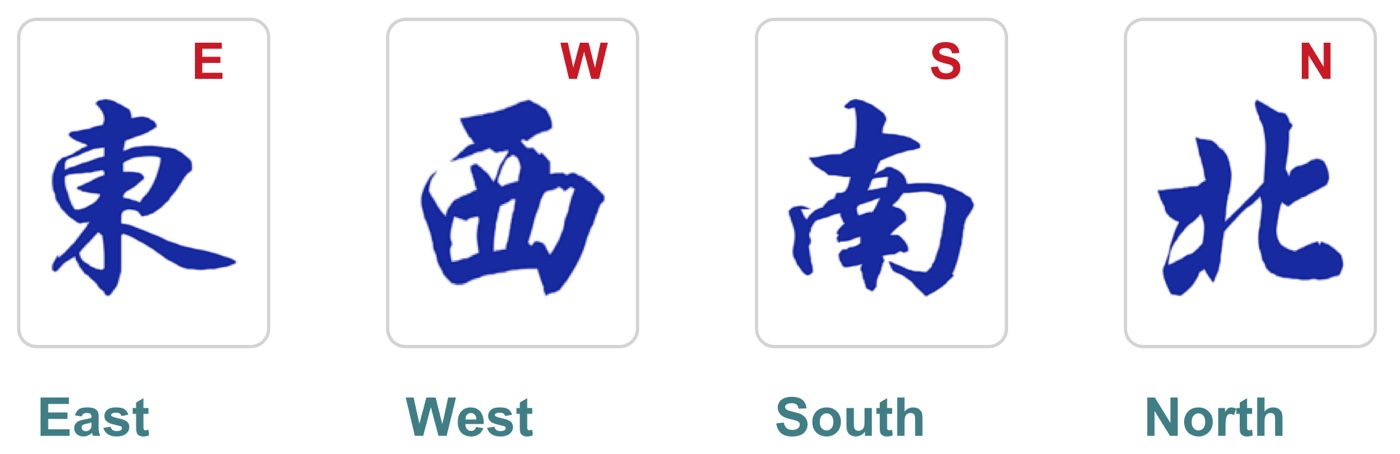
There are four copies of each Wind: East, West, South, and North. Match the letter to the Chinese character.
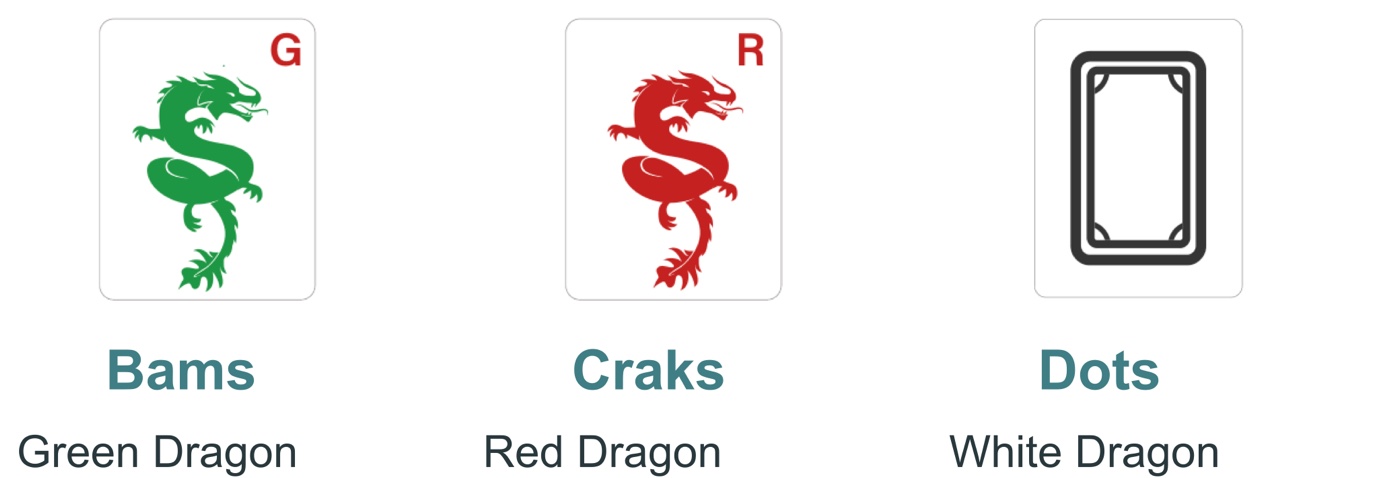
Matching Dragons
There are four copies of each Dragon, and each Dragon is associated with one suit: Green with Bams, Red with Craks, White with Dots. The White Dragon is also called Soap. It may represent 0 on the card. These pairings are printed along the edge of every 2F22E mat.
Flowers and seasons

Standard NMJL play uses 8 Flowers. Flower and season designs are interchangeable: any of these eight tiles may represent F on the card, regardless of its picture or number. Flowers remain in your hand and are not replaced with extra draws.
Jokers

Standard NMJL play uses 8 Jokers. Jokers may substitute for tiles only in Pungs, Kongs, Quints, and Sextets, which are groups of three, four, five, or six matching tiles. They may never replace singles or pairs.
Learn the group names
A matching group repeats the same tile. For numbered tiles, both the number and suit must match.
Here every 5 is a 5 Bam and J means Joker. These are group illustrations, not complete hands. Jokers are allowed only in eligible Pungs, Kongs, Quints, and Sextets; singles and pairs must be natural tiles.
How to read the card
| F | Flower |
|---|---|
| D | Dragon |
| 0 | White Dragon, also called Soap |
| N, E, W, S | North, East, West, South |
| C | Concealed |
| X | Exposures allowed |
For numbered tiles, one color normally means one suit; different colors mean different suits. The colors do not permanently name Bams, Craks, or Dots. Parentheses control the permitted choices and any exceptions. Match the complete fourteen-tile pattern exactly. Do not change the group sizes shown on the card.
Read the parentheses
- Like
- Repeated numbers must agree.
- These Nos. Only
- Keep the exact printed numbers.
- Any 1 or 3 Suits
- Choose one suit or three suits; two is not an option.
- Any Consec. Nos.
- Shift the permitted run while preserving its intervals and group sizes.
- Any Dragon
- The written instruction permits any Dragon.
- Opp. Dragon
- Choose a Dragon belonging to a numbered suit that is not in use.
Lesson 03Walls, dealing & the Charleston
Build the walls
- Place the racks. Seat four players around the table and place one rack in front of each player.
- Shuffle the tiles. Set extra tiles aside. Turn the 152 playing tiles face down and mix them thoroughly.
- Build the walls. Each player builds a face-down wall 19 stacks long and 2 tiles high, for 38 tiles per wall. Arrange the four walls in a square. The wall guides printed on your 2F22E mat help line them up.
Break the wall and deal
East rolls two dice. From East’s own viewpoint, count that many stacks inward from the right end of East’s wall and separate those stacks. For example, with a dice total of 6 the gap leaves 6 stacks at East’s right; the wall still totals 19 stacks.
East begins with the two stacks immediately left of the gap. Turns go right around the players; tiles leave the wall toward the left. Keep these two directions separate.
Take four tiles per player in turn until each has twelve. Finish the deal with East holding 14 and the others 13.
After the Charleston and any Courtesy Pass, East discards first without drawing.
The Charleston
- First Charleston
- Pass 3 tiles to the right, then 3 across, then 3 to the left. The first Charleston is required unless East already has a complete legal Mah Jongg hand.
- Second Charleston
- If all four players agree, pass 3 tiles to the left, then 3 across, then 3 to the right. Any player may stop the Charleston before the second round begins. Once the second round starts, complete all three passes.
- Blind pass
- Only on the first Charleston’s final left pass and the second Charleston’s final right pass, you may pass along 1, 2, or 3 incoming tiles without looking at them. Your outgoing pass must still total 3 tiles.
- Courtesy pass
- Opposite players may agree to exchange 0 to 3 tiles. Each opposite pair decides separately. Both players exchange the same number; if their preferences differ, use the smaller number.
Blind-pass example: on an allowed final pass, send 1 tile from your rack plus 2 incoming tiles without looking at those 2. Your outgoing pass still contains 3 tiles.
Courtesy-pass example: you want 3 tiles; your opposite player wants 1. Exchange 1 each. If either chooses 0, that pair exchanges none. The other opposite pair decides independently.
Never pass a Joker during the Charleston or Courtesy Pass. Before every pass, count the tiles and check that no Joker is included.
Lesson 04Turns, claims & Joker exchanges
Your turn, step by step
- Get a tile. On a normal turn, draw one tile. A legal discard claim replaces the draw.
- Check your options. Can you win? If you called for an ordinary exposure, complete that group first.
- Exchange if eligible. You may redeem a Joker in a valid exposure on your turn, before discarding.
- Discard and name it. If you have not won, discard one tile face up and name it clearly.
Between turns: 13 tiles in total, including exposed tiles. Before your discard: 14. East skips the first draw and declares Mah Jongg if already complete. A Kong gives no replacement draw.
Calling a discard
Only the most recent discard may be claimed, and only while the calling opportunity remains open.
For an exposed hand, you may claim a discard to complete a Pung, Kong, Quint, or Sextet permitted by the card. Reveal the complete group, then discard one tile without drawing from the wall.
2026 update: put the claimed tile on the rack’s top ledge, including a tile claimed to win.
You may claim a tile for a single, a pair, or a group of different tiles only when it completes your entire hand for Mah Jongg.
When the calling opportunity closes: a drawn tile does not automatically close it. It normally closes when the next player racks the drawn tile, discards, declares Mah Jongg, or announces a Joker exchange.
Calling priority
- A valid Mah Jongg claim takes priority over an ordinary exposure claim.
- If two players claim the same discard for Mah Jongg, the player next in turn from the discarder has priority.
- For ordinary competing claims, turn order normally decides. However, a caller who has already placed the claimed tile atop the rack or begun exposing matching tiles takes precedence.
Concealed and exposed hands
C means concealed: do not claim discards for ordinary exposures. You may still claim the final tile to declare Mah Jongg. X means exposures are allowed, not required. Jokers may be used in eligible matching groups within a concealed hand; they may never replace singles or pairs.
Joker rules
- Jokers may be used only in Pungs, Kongs, Quints, and Sextets. Flowers count as matching tiles regardless of their designs.
- Never use Jokers for singles or pairs, including tiles in NEWS or a year grouping such as 2026. (This is the reminder printed on your 2F22E mat.)
- Never pass Jokers during the Charleston or Courtesy Pass.
- A discarded Joker cannot be claimed, even for Mah Jongg.
Exchanging a Joker
On your turn, after drawing a tile or legally claiming a discard and completing its exposure, you may exchange a matching natural tile for a Joker in your own or another player’s valid exposure. Complete the exchange before discarding.
You may not claim a discard solely to redeem a Joker. You may not use a newly redeemed Joker to finish an incomplete exposure that you have just called.
A valid exposed Kong represents four 5 Bams, with one Joker:
You hold a natural 5 Bam on your turn. Offer the matching 5 Bam and receive the Joker. The exposure is now a full Kong of 5 Bams, and the redeemed Joker joins your concealed tiles.
Do not call a discarded 5 solely to make this exchange, and do not borrow this Joker to finish an incomplete exposure you just called.
Lesson 05Winning & scoring
Declaring Mah Jongg
Your fourteen tiles must match a complete legal hand on the current card, including its suit requirements, group sizes, and parenthetical instructions. Announce “Mah Jongg” and display the complete hand for verification. If claiming a discard to win, announce your claim while the calling opportunity remains open.
American Mahjong does not use chow calls. A Kong is a four-tile group specified by the card; it does not give you a replacement draw.
Check the complete hand
- 14 tiles in the exact printed pattern
- Correct suits and matching Dragons
- Correct group sizes and Joker use
- All parenthetical instructions followed
Score the win
Start with V, the value printed beside the completed hand on the current card. Track the result with chips, on paper, or on the printable scorecard.
| Winning route | Discarder pays | Each other opponent pays |
|---|---|---|
| Discard win | 2 × V | 1 × V |
| Self-picked win | All three opponents pay 2 × V | |
| Eligible Jokerless win | Double the amounts above | |
The Jokerless bonus excludes Singles & Pairs hands. Announce an eligible Jokerless win when scoring.
Example, printed value 25: a discard win collects 50 from the discarder and 25 from each other opponent. A self-picked, eligible Jokerless win collects 100 from each opponent.
A Joker redemption that completes your hand counts as self-picked. If the wall runs out with no winner, it’s a wall game and nobody pays. Follow the organizer’s scoring at tournaments.
Lesson 062026 reminders & beginner strategy
These notes are specific to the 2026 NMJL card. Check the current year’s card before relying on them.
Six Flowers are not always one group
Some hands require one Sextet of Flowers. Others require two separate Pungs of Flowers. Follow the grouping printed on the card: do not expose a Sextet as two Pungs, or combine exposed Pungs into a Sextet. In 2468 #7, the Flowers form two separate Pungs.
Soap as zero
As 0, Soap has no numbered suit. Its ink color does not tie it to Dots. Zero belongs only where the card prints 0.
Floating pair: 369 #5
The duplicate can be 3, 6, or 9; the Kongs follow that choice in the other two suits. The partial patterns read 3369 (pair of 3s), 3669 (pair of 6s) or 3699 (pair of 9s). Consult the complete printed line.
Adjacent symbols can be separate
In Winds-Dragons #6, 2EE means one numbered single and an East pair, not a Pung. Do not infer a new hand from spacing alone. Verify the complete printed line.
Beginner strategy (guidance, not rules)
- Compare realistic options
- Use your starting pairs as clues, then compare two or three legal hands on the current card.
- Check before you pass
- Check suits, singles, pairs, Flowers, Dragons, and Joker requirements before choosing tiles to pass.
- Reassess after each pass
- No number or Dragon is always safe to pass or always worth keeping. Keep tiles that support your strongest realistic options, and reassess after each Charleston pass.
- Understand the number family
- Treat 369 as its own number family: it includes the even number 6.
- Check exposures before switching
- Before changing hands, check every existing exposure. Shared tiles alone do not make a switch legal. Exposed groups must retain their required structure and remain compatible with the new hand.
Consider passing tiles that do not support your candidate hands.
Lesson 07Practice quiz & table checklist
Try it before you play
Answer each question before opening it. Keep the current card beside you.
1May a Joker fill the missing tile in a pair?
No. Singles and pairs require natural tiles.
2May you call the last tile of NEWS to win?
Yes, if it completes a legal hand and the calling opportunity is still open.
3Must a hand marked X have an exposure?
No. X permits exposures; it does not require them.
4Your opposite player wants 0 tiles; you want 3. How many do you exchange?
Zero. Use the smaller agreed number.
5Can you expose six Flowers as one Sextet when the card shows two Pungs?
No. Keep the two Pungs separate.
6Can you call a discard solely to exchange it for a Joker?
No. The discard must complete a permitted exposure or the entire winning hand.
7East finishes the Charleston with 14 tiles. Draw or discard?
Discard without drawing, unless East can declare a legal Mah Jongg.
8Does a Kong earn a replacement tile?
No. A Kong gives no replacement draw.
Build one real hand slowly
Choose a line on your current card. Lay out all 14 tiles, leave visible gaps between groups, and explain the suits, singles, pairs, and Joker positions to a partner. Check the parentheses together.
Avoid costly mistakes
- Do not pick ahead
- Wait for your turn before drawing or looking at a wall tile. Blanks and hot/cold-wall rules are house variations, not the standard game taught here.
- Know when an exposure locks
- After claiming, any permitted correction to that exposure must precede a Joker exchange or discard. A claimed tile cannot go back to the discards.
- Check before declaring a hand dead
- Wrong tile counts, illegal exposures, or an impossible exposed pattern can disqualify a hand. Judge tile availability only from public information, not your concealed tiles. Disputed challenges and mistaken Mah Jongg declarations have specific procedures and penalties: keep the tiles in place and consult the current rulebook; at a tournament, ask the director. Once your hand is confirmed dead, stop taking turns.
At-the-table checklist
- Before the deal
- 152 playing tiles; 8 Flowers; 8 Jokers. Build four walls of 19 stacks, two tiles high.
- After the deal
- East has 14; everyone else has 13. Complete the agreed Charleston sequence; never pass a Joker.
- On a normal turn
- Draw one tile, consider a legal Joker exchange, then discard and name one tile. A legal claim replaces the draw.
- Before calling
- Check the most recent discard, calling opportunity, C/X marking, group size, and the complete card requirements.
- Before declaring Mah Jongg
- Count all 14 tiles, including exposures. Verify every suit, single, pair, and printed instruction.
- If the wall runs out
- With no winner, the hand ends. East passes to the player on the right for the next deal.
Lesson 08Mat care
Your mat ships folded once so the box fits your mailbox. Expect a clear fold line on unboxing, a faint one by day 1, and a mat that lies flat by day 3.
- Unfold and lay flat. Open it on a clean table the day it arrives and leave it for 24 hours. A few tiles on top help it along.
- Add even weight. Put heavy books along the crease and leave them overnight.
- Warm, not hot. Only if needed: iron the fabric side on the lowest heat with a cotton cloth in between. Never iron the rubber side.
Between games
Fold once on the same line, roll it up and slide it into the bag. Clean with a damp cloth and keep the mat out of the sun.
Still creased after 3 days? Message us from your Amazon order (Your Orders → Contact seller) or contact us here. We’ll make it right.
SourcesReferences & next steps
This independent 2F22E course teaches four-player NMJL-style American Mahjong. It is not an NMJL rulebook or a replacement for the current card. Keep the current NMJL card, Mah Jongg Made Easy, and the latest League clarifications available. The 2026 notes on this page are specific to that year. 2F22E is not affiliated with the National Mah Jongg League.
- Tom Sloper: 2026 Card FAQ — sloperama.com/mjfaq/2026.html
- NMJL: January 2026 Bulletin — access through nationalmahjonggleague.org
- Tom Sloper: American Rules FAQ — sloperama.com/mjfaq/mjfaq19.html
- NMJL Online: League Rules Only — faqs.nmjlonline.com